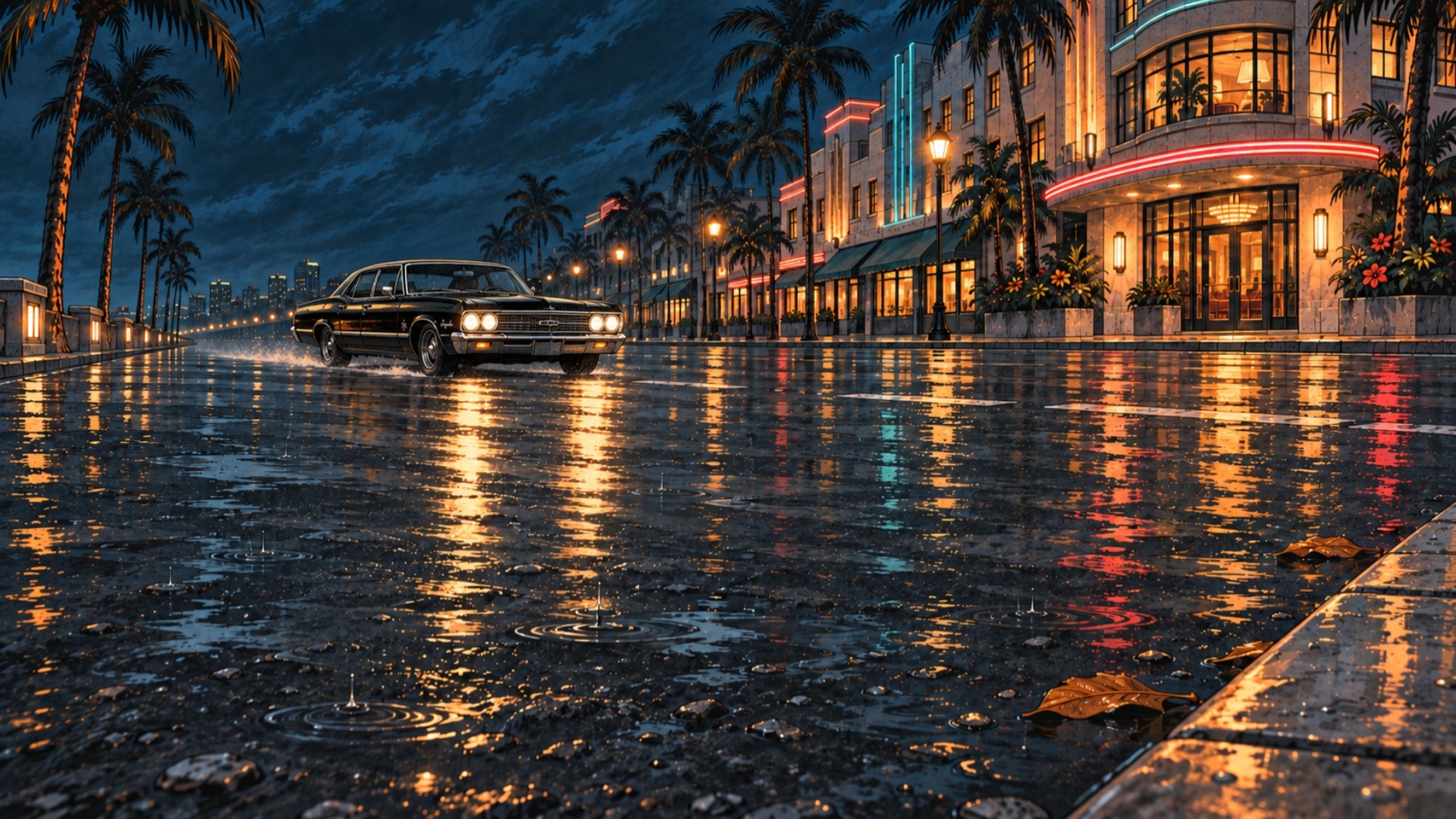
A single continuous 4-second shot, 16:9, 1080p. Use the reference image as the exact opening fram...
A single continuous 4-second shot, 16:9, 1080p. Use the reference image as the exact opening frame. Preserve the same black 1967 Chevrolet Impala, wet boulevard, amber and cyan reflections, and hand-inked graphic-novel style. The camera is fixed at the edge of the sidewalk, almost touching the wet asphalt, as if the viewer were lying beside the curb. Keep that very low angle and the same framing for the entire shot. No camera movement, zoom, shake, or cuts. 0.0–0.9 s: From the very first frame, the Impala is already racing toward us from the middle distance on screen left. It rapidly closes the gap, moving diagonally toward screen right and the foreground. Its wheels are already spinning fast, and a low trail of water follows behind it. The engine is already loud and under load as the shot begins. 0.9–2.9 s: The Impala goes into one sharp, continuous drift. Its nose sweeps toward screen right while its right rear quarter swings toward the camera. Keep the car moving across the asphalt throughout the slide. The right rear wheel grows rapidly in frame as it approaches the lens. A low fan of water sprays out from under the tire and catches the red taillight. Let a short, rough tire squeal and the hiss of wet rubber cut through the engine sound. 2.9–4.0 s: The Impala stops just short of the camera, still on the road. Hold on the right rear wheel, slightly right of center and filling roughly half the frame height. The rim and tire come to a complete stop together. The last few droplets travel past the motionless tire. The tire squeal cuts out at the stop, and the engine drops to a low idle. Audio contains only the engine, the tires sliding on wet asphalt, and the spray kicked up by the drift. No music, voices, horns, or sirens.
Free to start · Generate videos and images with AI in seconds