Image - 2026-08-24 08:39
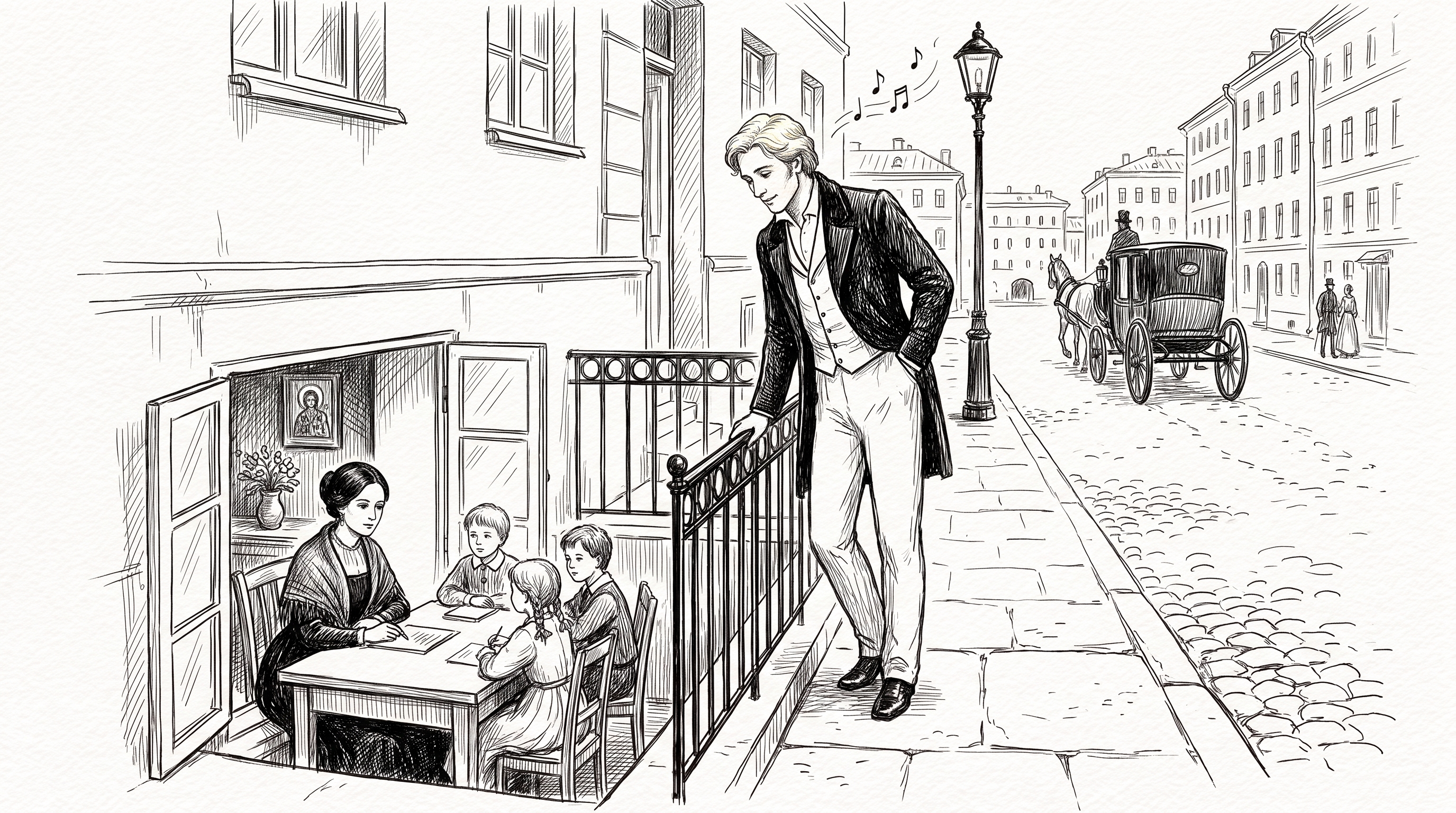
Transform this image into a pen-and-ink drawing in the style of Pushkin's manuscript illustrations, while strictly preserving the exact facial features, costumes, and character identities from the source reference images. CRITICAL — CHARACTER ACCURACY (MAXIMUM PRIORITY): Andreev: Must remain EXACTLY as in the reference — blond hair, fair skin, specific facial features, eye shape, nose, mouth, expression. His face must be immediately recognizable as the same person from the reference. Do not alter or stylize his features — only change the rendering technique to ink lines. Nina: Must remain EXACTLY as in the reference — her specific face, hair, eyes, expression, and posture must be preserved identically. She must be immediately recognizable as the same person from the reference. Costumes: Copy the exact costumes from the references — Andreev's light summer coat or jacket, white shirt, specific cut and details; Nina's simple dress, shawl, hair style. Preserve all identifying clothing details. Children: Their faces and clothing should be derived from the reference materials as well — maintain their individual appearances. DO NOT change, idealize, or generalize the faces. Do not make them more "beautiful" or "generic." Keep every unique, specific feature from the references. The result should look like Pushkin sketched these exact people from life — a portrait of the specific individuals from your references. Scene: Millionnaya Street, Saint Petersburg, late 19th century, summer. Vasily Andreev — young violinist, early 20s, blond (as in reference), with fair skin and light eyes — walks alone along the sunlit cobblestone street. He wears the exact costume from the reference image — light summer coat or dark open jacket over a white shirt, no hat. His face shows the tension of a recent argument, but he is softening as he looks down at the basement window. He has stopped beside a small basement window at street level, leaning forward, one hand resting on the iron railing. The window is open — summer breeze moves the white curtains inside. Inside the basement, visible through the open window: a young woman — Nina (exactly as in the reference image) — sits at a simple wooden table, surrounded by four or five poor children. She teaches them to read, holding a small book or chalk slate. Her face is gentle, kind, matching the reference precisely. The children are attentive, some barefoot, all with bright eyes. The room: Humble but cozy — a vase with wildflowers on the windowsill, a few books, a simple icon in the corner. Andreev's posture: Frozen, captivated. His troubled expression has softened into wonder. He cannot look away. Sunlight falls on his face. The street behind him: A cast-iron lamppost, passersby in the distance — a gentleman, a woman with a parasol, a carriage. The Vitebsky Railway Station or elegant mansions in the background. Atmosphere: Warm summer light, soft shadows on cobblestones. A few faint musical notes float in the air above Andreev's head — barely visible, like an emerging melody. Style: Pure black ink on clean white paper — no colors, no sepia, no grey tones. Pushkin's characteristic style: light, flowing pen strokes, delicate linework, generous white space, slightly sketchy and unfinished quality. The characters' faces must be drawn with the highest precision — every line should serve to preserve their identity. Hand-drawn quality with visible searching lines and slight imperfections. Atmospheric and cinematic. Technical: Monochrome, black ink on white paper, Pushkin illustration style, characters strictly based on reference images, maximum facial accuracy, specific costumes preserved, recognizable individuals, romantic and theatrical, --ar 2.39:1
Free to start · Generate videos and images with AI in seconds
More from this creator



More Kie.ai images
См. все →