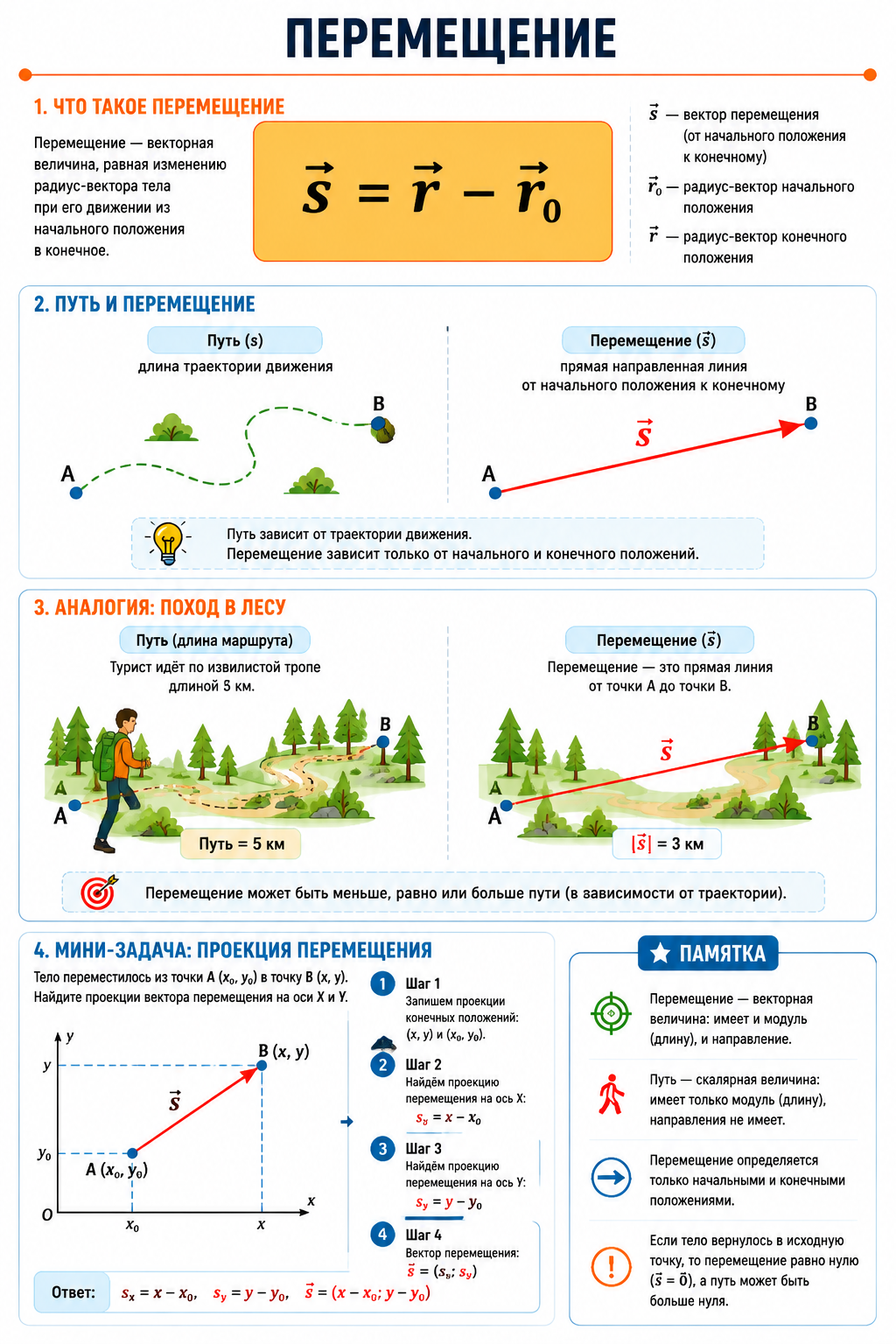









A professional educational physics cheat sheet for 9th grade, styled as 'Physics in Pictures', formatted as a single vertical A4 page infographic, JPEG layout. Clean white background with a minimalist flat vector design, using the exact visual style, structure, and color scheme from the uploaded reference image: a dominant bright yellow-orange background for the main formula block, dark blue/navy for primary titles and headers, light blue for secondary section outlines, and accents of bright orange, green, and red for icons and highlights. At the top, the bold title in Russian reads 'ПЕРЕМЕЩЕНИЕ'. Below it, the layout is divided into clear sections with lots of negative space: 1) A large, prominent central formula block showing the displacement vector formula 's = r - r0' (or simply demonstrating the vector 's' with an arrow over it) inside a bright yellow rounded rectangle with a thin orange outline, with definitions of 's' (displacement vector), 'r0' (initial position), and 'r' (final position). 2) A clear, simple diagram illustrating the difference between 'Путь' (Path/Distance - a curved dotted line) and 'Перемещение' (Displacement - a straight solid vector arrow connecting the starting point A to the ending point B). 3) An analogy or example section showing a hiker walking along a winding forest path (curved line) compared to their direct displacement vector (straight arrow), using the same clean, flat vector illustration style with trees and a small character. 4) A mini-task section with neat steps (Шаг 1, Шаг 2, Шаг 3, Шаг 4) calculating the projection of the displacement vector on the coordinate axes (sx = x - x0), and a blue 'Памятка' note block at the bottom right explaining the key differences: displacement is a vector quantity (has direction), while path is a scalar quantity (only has magnitude). The overall aesthetic is clean, modern, educational, using crisp lines, flat design, and an organized textbook infographic style.
Free to start · Generate videos and images with AI in seconds